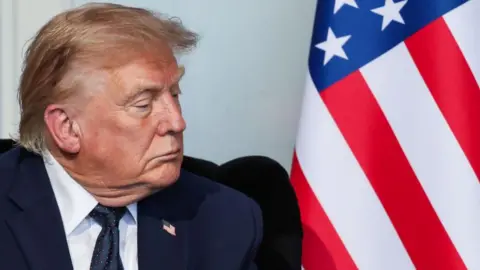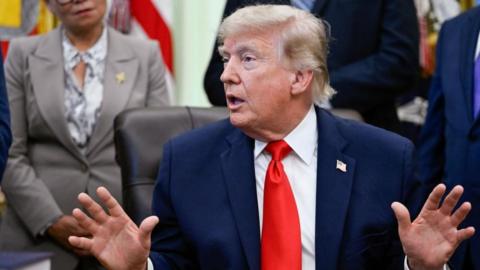
In the lead-up to the 2024 presidential election, women's reproductive rights, particularly the implications of abortion policies, are shaping voters' decisions. The election comes after the controversial Supreme Court decision that overturned Roe v. Wade, thereby altering the national discourse on abortion. Polling indicates a noticeable gender divide, with Kamala Harris reportedly gaining support among women voters, while Donald Trump maintains an edge among men.
Michelle, a quality engineer from Arizona and a registered Republican, reveals her intent to vote for Harris due to her concerns over women's healthcare and rights. "I'm not a one-issue voter, but that is huge," she says, reflecting on her experiences in the medical field following the Roe v. Wade reversal. She questions the Republican stance on personal liberty, expressing discontent with the government's intrusion into personal medical decisions.
Contrastingly, a Texas nurse practitioner who supported Trump in 2020 remains loyal, emphasizing her focus on policies over personality. She critiques Harris for lacking clarity on abortion gestational limits, stating, "I care about women's rights. The mother is the first patient," suggesting an inclination to prioritize maternal health in her voting decision.
In Illinois, a Democrat voter echoes these sentiments, highlighting her concern about the direction of reproductive rights under Trump's leadership while recognizing a potential shift in electoral dynamics. "Trump's attempts to communicate that he understands why reproductive rights are important have fallen woefully short," she contemplates, associating Harris’s candidacy with a deeper understanding of women's issues, given her background.
Voter indecision also marks this election, with one library assistant considering a write-in candidate. "It's great to have a female running seriously, but my views on Harris’s policies don’t fully align," she shares, illustrating the complexities women face beyond party affiliation.
Angela, a graduate student in Iowa and a Biden supporter, expresses discontent with both candidates' approaches to abortion, although she acknowledges Harris's intent to codify Roe v. Wade. "Neither candidate addresses women’s rights comprehensively," she reflects, pointing to the nuances of women's rights beyond abortion access.
Opinions diverge sharply among voters, with a retired Republican staunchly supporting Trump while critiquing Harris’s competence, suggesting her focus on abortion issues lacks substantive policy depth. "Trump is sensible," she asserts, viewing autonomy in legislation as a calculated approach.
An independent voter from Florida underscores her commitment to reproductive rights, advocating for inclusive policies that protect various demographics: "It starts with women, but extends beyond that."
On the other end of the spectrum, a Georgia voter with anti-abortion views expresses frustration at not aligning with either candidate. "As a Catholic, I struggle with voting for someone whose stance contradicts my beliefs," she remarks, capturing the moral dilemmas many face.
Lastly, a retired voter emphasizes a pervasive sense of fear regarding the future of women's rights, distraught over the prospect of regression. "It's disturbing to think my granddaughter will have fewer rights," she laments, indicating that several voters share similar anxieties about the evolving political landscape surrounding women's autonomy.
As election day approaches, the discourse surrounding reproductive rights remains integral to understanding women's voting behavior, revealing a mosaic of perspectives shaped by personal values, political beliefs, and societal impacts.