Israel has postponed the demolition of a Palestinian children's football club in the city of Bethlehem, in the occupied West Bank.
It said the Aida Youth Centre's pitch was constructed without the necessary permits. It argued that the demolition was necessary for security reasons.
However, an international campaign to save it, including a petition with more than half a million signatures, seems to have influenced the authorities to reconsider the demolition. The club, nevertheless, reported that it had not yet received any official notification.
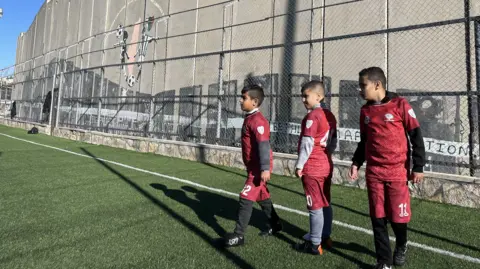
The pitch is small, only a fraction of the size of a traditional football field, with rusting goalposts. Despite its modesty, it has sparked a significant international campaign for its survival. This fight represents a larger struggle against the backdrop of the ongoing Israeli-Palestinian conflict.
The demolition order, issued back in December, followed a notice declaring the field illegal, alarming the local children and community. Young players expressed their distress, saying the pitch is vital for their dreams and aspirations.
Pursuing recognition and support, the local community launched a social media campaign and appealed to global football governing bodies, which, coupled with the international petition, seems to have prompted this delay.
While the Israeli military maintains that the proximity of the pitch to the concrete barrier poses security threats, it has now temporarily suspended the demolition order.
Since its construction in 2020, the pitch has served over 200 young players from the Aida refugee camp, a community shaped by the descendants of families forced from their homes during the 1948 Arab-Israeli war.
This incident underscores a broader narrative of struggle for small liberties amidst a complex and fraught political landscape where Palestinians contend with issues of land, rights, and security, particularly as Israel continues approving settlements in the occupied territories.
While the immediate threat to the football pitch may have been averted, community leaders remain cautious. Mohammad Abu Srour, a board member at the Aida Youth Centre, emphasized the importance of ongoing advocacy, recognizing that the situation could change without continued engagement and visibility.