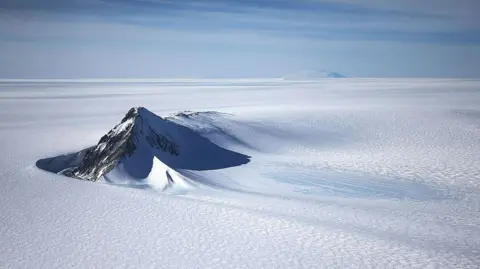
A new map has unmasked the landscape beneath Antarctica's ice in unprecedented detail, which scientists believe could greatly enhance our understanding of the frozen continent. Researchers have leveraged satellite data and the physics of glacier movement to illustrate what lies beneath the icy exterior of Antarctica.
The findings indicate the presence of thousands of previously undiscovered hills and ridges, with clearer maps of some hidden mountain ranges than ever before. While some uncertainty exists around the data, the enhanced detail has the potential to illuminate how Antarctica may react to climate change and its implications for global sea-level rise.
Lead researcher Dr. Helen Ockenden from the University of Grenoble-Alpes described the leap in understanding, likening it to upgrading from a grainy pixel film camera to a high-resolution digital image of the continent's geology. The researchers found out that more is known about the surface of some planets than the submerged landscapes of Antarctica.
By combining satellite data with their knowledge of ice dynamics, researchers uncovered numerous topographical features that traditional measurement methods, which were often limited to isolated survey lines, could miss. This discovery presents new insights into not only the icescape above but also the geological formation of the terrain beneath.
The implications of this research extend into predictions regarding how glacial movements might accelerate with warming climates — a vital query in climate science. As glaciers shift and retreat, understanding the morphology beneath is crucial for forecasting sea-level rise.
The study's insights are already being recognized as a valuable contribution to ongoing climatic studies. Dr. Peter Fretwell from the British Antarctic Survey emphasized that these findings allow researchers to fill gaps in prior data, improving models that predict how Antarctica's glaciers could behave in the future.
A greater understanding of Antarctica's hidden features may lead to improved accuracy in predicting global sea-level rise and the future implications of climate change — a substantial concern in the realm of environmental science.