In brief
Spanish rail authorities have imposed a temporary speed limit of 80 km/h on a segment of the high-speed rail line connecting Madrid and Barcelona. This decision follows the detection of a crack in the track and comes shortly after a railway disaster in southern Spain that resulted in 45 fatalities. While the transport ministry assures that the fault does not pose immediate danger, the move is seen as part of broader safety measures amid increasing scrutiny over rail safety in the country. Disruptions have also occurred in local Catalonia rail services, with ongoing investigations into rail safety exacerbating public concern.
Spanish rail authorities have temporarily reduced the speed limit on part of the high-speed line between Madrid and Barcelona after a fault was detected on the track.
Transport Minister Óscar Puente reported a crack was discovered on Sunday night in the line located 110km (68 miles) west of Barcelona, between Alcover and l'Espluga de Francolí in Catalonia.
This decision comes days after a high-speed collision that killed 45 people in southern Spain and amid severe disruption to local rail services in the north-east of the country.
The transport ministry stated that the fault in the line does not pose a danger to trains travelling along it and that operations will continue.
The speed limit on the affected track section will be set at 80km/h (50mph) until further notice. High-speed trains generally travel up to 300km/h between Madrid and Barcelona, one of Spain's most frequented long-distance routes.
Recently, the speed limit on portions of the Madrid-Barcelona line was lowered to 230 km/h after drivers reported vibrations and other anomalies, but it was restored to 300km/h once technical checks were completed.
Additionally, various segments of the Madrid-Valencia line had their speed limits temporarily reduced to 160km/h and 200km/h.
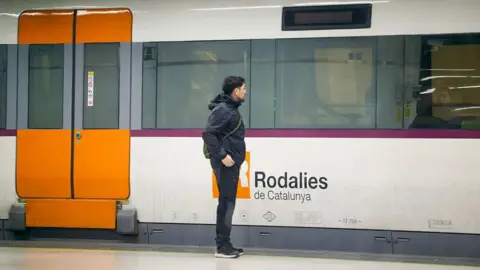
In Catalonia, the local Rodalies rail service has faced severe disruptions, especially after a trainee driver was killed in an incident involving a collapsed wall. Drivers subsequently demanded better safety assurances, leading to a review of the lines.
On Monday, additional incidents further affected services, with the government investigating possible cyberattacks as a cause.
Political responses have included calls for accountability as the Catalan Republican Left (ERC) party highlighted longstanding underinvestment in the Rodalies network. Critics argue that the current reputation crisis could surpass economic losses.
Prime Minister Pedro Sánchez is scheduled to address Congress on February 11 regarding the rail crisis.
As investigations continue into the recent high-speed crash in Adamuz, where a section of track failed and led to a train collision, the transport ministry is under scrutiny for its oversight and response to rail safety.
Opposition figures are demanding the resignation of Minister Puente, accusing him of misleading the public in the wake of the incidents.