In brief
As the US and China engage in a high-stakes competition for AI dominance, each nation showcases unique strengths. America excels in creating advanced AI 'brains' while China leads in developing AI 'bodies' like humanoid robots. The race is not just technological; it reflects deeper strategic goals as both countries aim for global influence in an increasingly tech-driven world.
In the second half of the 20th Century, the race to develop nuclear arms captivated the greatest minds in the US and the Soviet Union; today, a similar contest unfolds in the realm of artificial intelligence (AI), with the US and China vying for technological supremacy. This competition manifests not only in research labs and startups but also resonates in the highest echelons of government and corporate leaders, influencing trillions of dollars in investments.
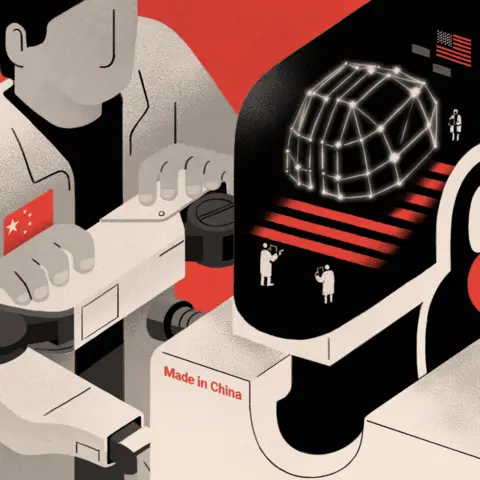
As Nick Wright from University College London articulates, the battle can be framed as one between 'brains' and 'bodies'. The US leads in AI 'brains', focusing on chatbots, microchips, and large language models (LLMs) like OpenAI's ChatGPT, used weekly by over 900 million people. However, China has gained a lead in AI 'bodies', particularly humanoid robots, thanks to substantial government backing and robust manufacturing capabilities.
The launch of ChatGPT in late 2022 not only revolutionized AI interactions but spurred an intense race among American companies to develop competing LLMs. While the US continues to hold the lead in advanced AI capabilities, recent developments from China, particularly with the introduction of the AI chatbot DeepSeek in 2025, have stirred concerns in Washington. DeepSeek, developed at a significantly lower cost, showcased that China was capable of developing advanced AI systems without access to the highly sophisticated chips typically controlled by the US.
Moreover, America's stringent export controls on microchips, designed to inhibit China's access to advanced technology, appear to have inadvertently encouraged Chinese innovation and self-reliance in AI development.
Emerging from the depths of China's AI ecosystem, an open-source approach contrasts sharply with the US's proprietary model, fostering rapid innovation among Chinese tech companies. Meanwhile, China excels in producing humanoid robots, driven by a pressing need to address an aging population and focusing on filling gaps in care and labor.
The competition is further intensified as both nations race to integrate robots with agentic AI, which empowers machines to execute complex, varied tasks without human intervention. While America's firms like Boston Dynamics showcase cutting-edge robotics, the question remains—who will ultimately prevail in this multifaceted race for AI dominance?
As we advance into an uncertain future shaped by technology, the implications of this race on global influence and economics remain profound. The outcome is not simply about who reaches the finish line first, but rather about sustaining technological leadership across multiple domains.