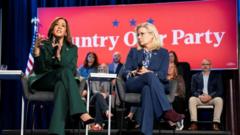
The recent collaboration between Vice President Kamala Harris and former Congresswoman Liz Cheney reflects a unique approach to courting anti-Trump Republicans in critical battleground states. On Monday, Harris ventured through Pennsylvania, Michigan, and Wisconsin, conducting “town hall” style discussions that aimed to resonate with a traditionally Republican audience, a notable shift from her usual campaign rally format.
This strategic endeavor comes as these three states, often referred to as the Democratic Party’s "blue wall," have become essential for capturing electoral votes. Polls indicate a contentious race, underscoring the necessity for Democrats to attract independent and disaffected Republican voters. Cheney, known for her vocal opposition to Donald Trump and a key figure in the January 6 investigation, served as a significant cohost in these discussions, engaging with the audience on political matters.
Engagement in suburban counties was intentional, targeting college-educated individuals who may have previously identified as Republican. The backdrop of shifting political alliances offers a fertile ground for Democrats, as traditional voting blocs have seen fundamental changes in recent years. Republican strategist Craig Snyder emphasized the need for Democrats to communicate directly with conservative voters, leveraging voices like Cheney to provide a sense of community and support for those who may feel marginalized within their party.
During the town hall events, Cheney conveyed a message of conscience to attendees, suggesting that many Republicans might choose to diverge from party lines in light of character concerns regarding Trump. Her comments resonated with many in the crowd, with anecdotes surfacing about Republicans quietly thanking her for her stance against the former president. Harris poignantly highlighted that Republican admiration for Cheney's resolve indicates a broader, quieter rebellion among conservative voters unsure about their party’s direction.
The discussions consistently cycled back to pressing national issues, allowing Harris to articulate her campaign priorities. Topics included healthcare, foreign policy regarding Ukraine, and contentious reproductive rights debates, facilitating Cheney’s unexpected agreement on some issues. This bipartisan front, while seemingly improbable, underscores a growing frustration with Trump's leadership among some Republican circles.
Polls presently show a highly competitive race within these states, raising the stakes as both parties vie for every possible voter. An essential question remains: can Harris’s outreach effectively sway those Republicans who have expressed dissatisfaction without fully committing to the Democratic camp? Recent surveys indicate that fewer than 10% of Republicans are likely to switch allegiance, leaving the potential impact of “shy Republicans” uncertain. Should Cheney's predictions materialize, Harris’s campaign could gain crucial traction in these battlegrounds.
Harris and Cheney's alliance not only seeks electoral gains but also serves as a symbolic stand against the divisive politics that have characterized recent years. As the election approaches, the outcomes in these states could very well redefine the landscape of American politics.
This strategic endeavor comes as these three states, often referred to as the Democratic Party’s "blue wall," have become essential for capturing electoral votes. Polls indicate a contentious race, underscoring the necessity for Democrats to attract independent and disaffected Republican voters. Cheney, known for her vocal opposition to Donald Trump and a key figure in the January 6 investigation, served as a significant cohost in these discussions, engaging with the audience on political matters.
Engagement in suburban counties was intentional, targeting college-educated individuals who may have previously identified as Republican. The backdrop of shifting political alliances offers a fertile ground for Democrats, as traditional voting blocs have seen fundamental changes in recent years. Republican strategist Craig Snyder emphasized the need for Democrats to communicate directly with conservative voters, leveraging voices like Cheney to provide a sense of community and support for those who may feel marginalized within their party.
During the town hall events, Cheney conveyed a message of conscience to attendees, suggesting that many Republicans might choose to diverge from party lines in light of character concerns regarding Trump. Her comments resonated with many in the crowd, with anecdotes surfacing about Republicans quietly thanking her for her stance against the former president. Harris poignantly highlighted that Republican admiration for Cheney's resolve indicates a broader, quieter rebellion among conservative voters unsure about their party’s direction.
The discussions consistently cycled back to pressing national issues, allowing Harris to articulate her campaign priorities. Topics included healthcare, foreign policy regarding Ukraine, and contentious reproductive rights debates, facilitating Cheney’s unexpected agreement on some issues. This bipartisan front, while seemingly improbable, underscores a growing frustration with Trump's leadership among some Republican circles.
Polls presently show a highly competitive race within these states, raising the stakes as both parties vie for every possible voter. An essential question remains: can Harris’s outreach effectively sway those Republicans who have expressed dissatisfaction without fully committing to the Democratic camp? Recent surveys indicate that fewer than 10% of Republicans are likely to switch allegiance, leaving the potential impact of “shy Republicans” uncertain. Should Cheney's predictions materialize, Harris’s campaign could gain crucial traction in these battlegrounds.
Harris and Cheney's alliance not only seeks electoral gains but also serves as a symbolic stand against the divisive politics that have characterized recent years. As the election approaches, the outcomes in these states could very well redefine the landscape of American politics.