In brief
The preliminary tallies left Netanyahu’s right‑wing bloc short of a 61‑seat majority, with the opposition gaining 48 seats. Arab parties are poised to hold the balance of power with a record 19 seats. The complete results are expected by Friday, adding uncertainty to Israel’s political future.
On October 28, Israeli vote totals revealed that no single party had secured an outright majority, while Arab parties set a record with 19 seats in the 120‑member Knesset.
The United Press International reported that Netanyahu’s right‑wing bloc was projected to win 53 seats, down 15 from the previous parliament, while the opposition led by former military chief Gadi Eisenkot captured 48 seats. The UPI count also noted that the Arab bloc would hold 19 seats, 12 for the Joint List and 7 for Ra’am, surpassing the 15 seats recorded in 2020.
In contrast, Al Jazeera’s earlier coverage, citing a snapshot when nearly 80 percent of votes had been tallied, said the Netanyahu bloc had 54 seats and the opposition 49, with the Arab‑dominated Ra’am and Joint List holding 17 seats. The outlet stressed that the final count was not yet complete and would likely finish by Friday, with official results to be published on November 4.
Xinhua reported a sharper picture of market reaction. Tel Aviv stocks fell sharply, with the benchmark TA‑35 index down 1.81 percent and the broader TA‑125 down 2.46 percent. The TA‑90 index plunged 4.47 percent, and the TA‑Banks‑5 fell 4.85 percent. The Israeli shekel weakened against the U.S. dollar, falling 1.62 percent to 3.128 shekels per dollar.
Gad Lior, a senior analyst at the Israeli daily Yedioth Ahronoth, explained that the sell‑off was driven by political uncertainty and concerns over another Netanyahu‑led government’s ability to address economic challenges.
"The sell‑off was driven by political uncertainty and concerns that another Netanyahu‑led government might again struggle to address economic challenges," stated Lior.
Joseph Freiman, CEO of Israeli financial group Prico, told Xinhua that shifting election results had reversed the shekel’s earlier gains, noting that most projections early in the day favored the opposition, but as counting progressed Netanyahu’s bloc gained the lead, turning investor sentiment.
"...shifting election results had reversed the shekel's earlier gains," Freiman said.
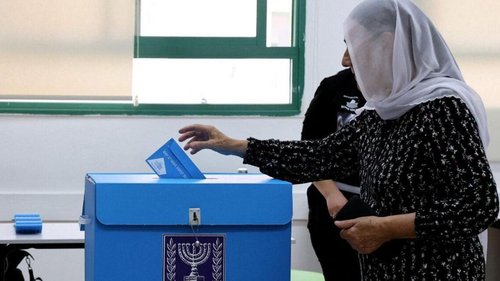
Both UPI and Al Jazeera noted that voter turnout reached 77.7 percent, the highest in Israel since 1999. UPI highlighted that the Central Elections Committee reported that 5.7 million of 7.3 million eligible voters cast ballots, while Al Jazeera added that turnout among Palestinian citizens of Israel reached about 80 percent, potentially driven by increased pressure on the minority following the Hamas attack of October 2023.
In a social media post, Gadi Eisenkot declared that the preliminary results indicated a “complete distrust” in Netanyahu and the October 7 government. He described the outcome as a victory for the statist‑Zionist majority in Israel.
"The preliminary poll results point to complete distrust in Netanyahu and the government of Oct. 7, of the Zionist majority and the majority of Israeli citizens," Eisenkot wrote.
Netanyahu, speaking to supporters, emphasized that his bloc held a decisive majority among the Jewish and Zionist public and called Likud the largest party in Israel, urging the establishment of a strong right‑wing national government.
"We must establish a strong, right‑wing, national government," Netanyahu told supporters.
The absence of a clear majority means that both Netanyahu’s and Eisenkot’s alliances will need to seek support from outside their respective camps to form a governing coalition. While Netanyahu’s bloc could potentially consolidate with the Arab parties or another coalition partner, the high stakes and political polarization suggest a prolonged negotiation process.
President Isaac Herzog will soon consult party leaders on whom to appoint as prime minister. The appointed candidate will have up to 28 days, extendable by 14, to build a coalition; failure could result in a new mandate or the dissolution of the Knesset for a return to the polls, with the current cabinet serving as caretaker.
With elections completed, Israeli society faces a delicate period of coalition building that could determine whether the next government continues the current right‑wing agenda or introduces broader inclusion, including the influential Arab bloc that now holds the balance of power.