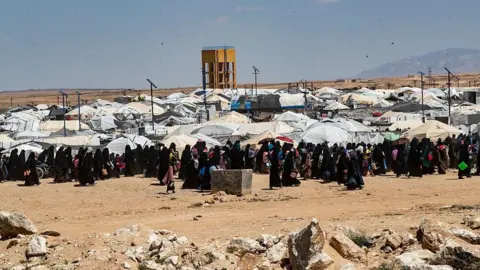
Syria's government has announced a new ceasefire with the Kurdish-led Syrian Democratic Forces (SDF), following the militia alliance's withdrawal from a camp that held thousands of individuals with alleged ties to the jihadist group Islamic State (IS).
The SDF stated that its forces were compelled to leave the al-Hol camp and redeploy to other areas in north-eastern Syria, citing international indifference regarding the situation of IS affiliates.
The Syrian interior ministry expressed concerns that the SDF's withdrawal occurred without coordination with the government or the US-led coalition against IS. Subsequently, the presidency announced it had reached an understanding with the SDF regarding the governance of Hassakeh province, where a significant Kurdish population resides.
A statement suggested that the SDF would have four days to consult on a detailed plan for peacefully integrating their controlled areas into the state framework. The presidency assured that government forces would not enter Hassakeh and Qamishli cities, nor any surrounded Kurdish villages.
The SDF reiterated its commitment to the ceasefire, with a promise not to initiate military actions unless provoked. They also emphasized readiness to implement agreements aimed at closing an extended period of conflict.
This deal marks a major setback for the SDF, which has been hesitant to concede the autonomy gained during military collaborations with the US-led coalition to defeat IS throughout Syria's prolonged civil war.
Interim President Ahmed al-Sharaa has committed to Syria's reunification after the successful offensive that ousted Bashar al-Assad in December 2024. However, the country continues to grapple with deep-seated divisions and violent sectarian strife.
The SDF's departure from al-Hol camp occurred as Syrian government troops accelerated their control of Hassakeh, including former IS strongholds in Deir al-Zour and Raqqa provinces.
Notably, the SDF's commander, Mazloum Abdi, conveyed apprehensions about the US-led coalition's failure to protect essential facilities, urging it to fulfill responsibilities amid these heightened threats.
The protracted conflict and recent discussions about the political future of northeast Syria stress the need for balanced solutions that can incorporate the rights and representation of various communities, including Kurds, while addressing security concerns tied to IS remnants.