Machines mining minerals in the deep ocean have been found to cause significant damage to life on the seabed, scientists carrying out the largest study of its kind say.
The number of animals found in the tracks of the vehicles was reduced by 37% compared to untouched areas, according to the scientists.
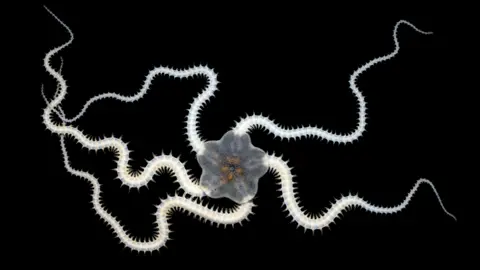
The researchers discovered more than 4,000 animals, 90% of which were new species, living on the seafloor in a remote area of the Pacific Ocean.
Vast amounts of critical minerals needed for green technologies could be locked in the deep ocean, but deep sea mining in international waters is very controversial and currently not permitted until more is known about the environmental impacts.
The research by scientists at the Natural History Museum in London, the UK National Oceanography Centre, and the University of Gothenburg was conducted at the request of deep sea mining company The Metals Company.
The scientists said their work was independent and that the company was able to view the results before publication but was not allowed to alter them.
The team compared biodiversity two years before and two months after the test mining that drove machines for 80km on the seafloor.
They looked specifically at animals measuring 0.3mm – 2cm in size, such as worms, sea spiders, snails, and clams.
In the tracks of the vehicle, the number of animals fell by 37% and the diversity of species by 32%.
The machine removes about the top five centimeters of sediment. That's where most of the animals live. So obviously, if you're removing the sediment, you're removing the animals in it too, lead author Eva Stewart, PhD student at the Natural History Museum and the University of Southampton, told BBC News.
Even if they are not killed by the machine, pollution from the mining operations could slowly kill some less resilient species, said Dr. Guadalupe Bribiesca-Contreras from the National Oceanography Centre.
Although some animals could have moved away, the long-term recovery of these populations remains uncertain. In areas near the vehicle tracks, the abundance of animals did not decrease as expected.
The study indicates potential for significant ecological consequences of current deep-sea mining practices, prompting experts to call for a reevaluation of large-scale commercial exploration.
Deep sea mining is controversial. At the heart of the debate is a difficult problem. The latest research took place in the Clarion-Clipperton Zone, a 6 million square kilometer area of the Pacific Ocean estimated to hold vast amounts of nickel, cobalt and copper-rich polymetallic nodules.
The world needs these critical minerals for renewable energy technologies to tackle climate change, leading to growing demand anticipated to at least double by 2040.
Environmental groups are gravely concerned that mining the deep seas could cause long-term damage, threatening not only the unexplored ecosystems but also the overall health of the oceans, already at risk from climate change.
The International Seabed Authority (ISA), which governs mining activities in international waters, has not yet approved commercial mining, although it has issued 31 licenses for exploration. A total of 37 countries, including the UK and France, are backing a temporary ban on mining.
The ongoing research highlights the pressing need for a balance between mineral extraction for technology and the protection of our planet's delicate marine ecosystems.