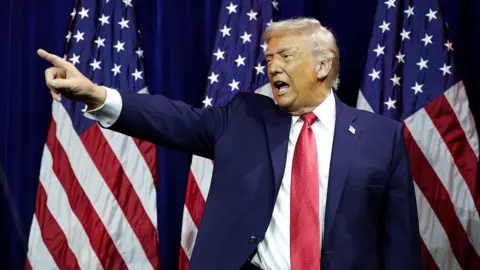
US President Donald Trump has withdrawn the US from dozens of international organisations, including many that work to combat climate change.
Nearly half of the 66 affected bodies are UN-related, including the Framework Convention on Climate Change - a treaty that underpins all international efforts to combat global warming.
Groups working on development, gender equality and conflict - areas the Trump administration had repeatedly dismissed as advancing globalist or woke agendas - are also included.
The White House said the decision was taken because those entities no longer serve American interests and promote ineffective or hostile agendas.
The memorandum was signed on Wednesday following a review, with the White House describing the organisations as a waste of taxpayer dollars.
These withdrawals will end American taxpayer funding and involvement in entities that advance globalist agendas over US priorities, it stated.
It further noted that many organizations promoted radical climate policies, global governance and ideological programs that conflict with US sovereignty and economic strength.
As well as the UN Framework Convention on Climate Change, the US has also withdrawn from the Intergovernmental Panel on Climate Change (IPCC) - the world's leading authority on climate science that compiles the most respected reports on climate change.
Sources within the organisation expressed concern about the potential impact of the Trump administration's decision on US scientists involved in producing the body's next set of studies.
The White House has already blocked US scientists from attending a meeting in China.
Any travel restrictions or limits on participation of US researchers could considerably delay the next series of IPCC reports, including its critical mitigation report - a key document guiding governments on how to address climate change.
Non-UN organisations affected by the US withdrawal include those focused on clean energy cooperation, democratic governance, and international security, such as the International Solar Alliance, the International Institute for Democracy and Electoral Assistance, and the Global Counter-Terrorism Forum.
Trump has previously stripped many multilateral organisations he dislikes of funds and has also rejected the scientific consensus on climate change, branding it a hoax.
The US is set to fully withdraw from the UNFCCC in one year; however, effective participation in the UN's climate change body has already ceased long ago.
The legality of this withdrawal may be contested in US courts, as campaigners are fiercely advocating for a challenge.
While the US Constitution allows presidents to join treaties provided two-thirds of Senators present concur, it does not clarify the process for withdrawal. A subsequent president may find reversing Trump's decision more complex than merely reapplying.
This latest withdrawal follows the president's recent withdrawal from the Paris Climate Agreement and refusal to send a delegation to the COP30 climate summit in Brazil.
Other international bodies the US has exited include the World Health Organization, the UN Human Rights Council, and UNESCO.
European leaders have criticized this decision, raising concerns over diminishing global cooperation. EU climate commissioner Wopke Hoekstra stated that the UNFCCC underpins global climate action and expressed that the US retreat is regrettable and unfortunate. EU's clean transition vice-president Teresa Ribera highlighted a lack of concern for environmental and humanitarian issues.
Members of US-based advocacy groups, such as the Union of Concerned Scientists, decried the move as a new low for the administration, which they characterized as authoritarian and anti-science, claiming it jeopardizes public welfare and disrupts global cooperation effort.