In brief
Jeremy Bowen discusses the current unrest in Iran amidst the backdrop of economic turmoil and political repression. He posits that while the Iranian regime faces significant challenges, it is not on the brink of collapse. The loyalty of security forces, the impact of international sanctions, and the presence of organized opposition are key factors in assessing the regime's stability.
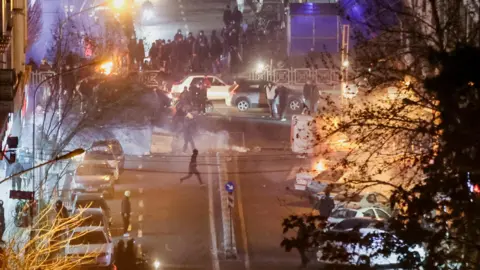
How does an authoritarian regime die? As Ernest Hemingway famously said about going broke – gradually then suddenly. The protesters in Iran and their supporters abroad were hoping that the Islamic regime in Tehran was at the suddenly stage. The signs are, if it is dying, it is still at gradual. The last two weeks of unrest add up to a big crisis for the regime. Iranian anger and frustration have exploded into the streets before, but the latest explosion comes on top of all the military blows inflicted on Iran in the last two years by the US and Israel. More significant for hard-pressed Iranians struggling to feed their families has been the impact of sanctions. In the latest blow for the Iranian economy, all the UN sanctions lifted under the now dead 2015 nuclear deal were reimposed by the UK, Germany and France in September. In 2025 food price inflation was more than 70%. The currency, the rial, reached a record low in December. While the Iranian regime is under huge pressure, the evidence is that it's not about to die. Crucially, the security forces remain loyal. Since the Islamic revolution in 1979 the Iranian authorities have spent time and money creating an elaborate and ruthless network of coercion and repression. In the last two weeks, the regime's forces obeyed orders to shoot their fellow citizens in the streets. The result is that the demonstrations of the last few weeks have ended - as far as we can tell in a country whose rulers continue to impose a communications blackout. At the forefront of the suppression is the Iranian Revolutionary Guards Corps (IRGC), a vital institution defending the ideology of the Islamic revolution. It has an auxiliary force, the Basij militia, which plays a central role in the regime's crackdown on dissent. The seeming resilience of these internal security forces does not mean that the supreme leader can relax; US President Donald Trump continues to pose a threat of action, while anger persists among millions of Iranians. In Tehran, the government is attempting to navigate this turmoil, mixing bellicose rhetoric with offers to negotiate with the US, showcasing their need to stabilize their grip on power amidst growing external and internal pressures. As protests frequently arise with renewed fervor, the key concern for the regime remains: could a more sudden collapse of authority occur, especially if leaders fail to address mounting dissatisfaction effectively? Ultimately, the future remains uncertain: the gradual decay may yet accelerate toward sudden upheaval.