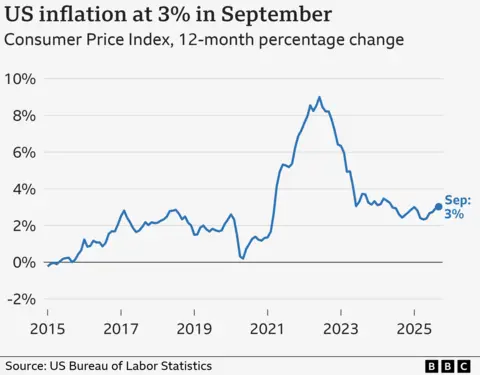
WASHINGTON (AP) — The economy in 2025 was marked by paradoxes, witnessing healthy growth rates despite a slowdown in hiring, persistent inflation, and rising unemployment. Economists and policymakers are left questioning the sustainability of this growth trend, pondering if a vibrant economic landscape can translate into job creation.
The unusual economic outcomes raise significant questions for the approaching year: Is the sluggish job market a prelude to deeper economic troubles, or can a flourishing economy eventually bolster employment opportunities? Additionally, advancements in technology, particularly artificial intelligence, could enable companies to increase output without additional hiring, leading to a concept termed a 'jobless expansion'.
Compounding the uncertainty is the aftermath of a six-week government shutdown, which disrupted economic data collection and left the Federal Reserve grappling with a more obscure understanding of current economic health. Stephen Stanley, chief economist at Santander, noted, “2026 begins at a time when it is hard to say how 2025 ended.”
A stark divide in wealth has emerged in the U.S., with an increasing share of consumer spending being attributed to wealthier households, which masks underlying weaknesses faced by lower-income families—a phenomenon often described as a 'K-shaped' recovery. Despite these obstacles, some economists remain cautiously hopeful. Stanley expects improved hiring rates as economic growth is expected to be driven by early-year tax refunds resulting from the Trump administration's tax cuts.
As the Federal Reserve aims for a clearer economic perspective, Governor Christopher Waller expressed optimism, hinting that 2026 might show promise for job growth as economic stability increases. However, the questions of inflation and job creation remain pressing, as policymakers strive to navigate these complex economic waters.
Amid trends of increasing consumer spending and lingering worries around inflation, American sentiment about the economy is at an all-time low despite an impressive growth rate achieving a remarkable 4.3% in some quarters. Furthermore, job growth stagnation followed the imposition of tariffs which cast companies into uncertainty and may have inhibited hiring. Ultimately, companies are figuring out the role of emerging technologies like AI in their production processes, causing a significant shift in how employment is viewed and approached in the modern economy.