The 'thorny' issues that threaten to derail a Russia-Ukraine peace deal
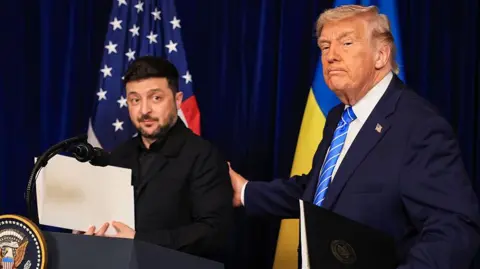
Russia, the US and Ukraine agree that a deal on ending almost four years of full-scale war is edging closer but, in the words of President Donald Trump, one or two very thorny, very tough issues remain.
Two of the trickiest issues in Washington's 20-point plan involve territory and the fate of Europe's biggest nuclear plant, which is currently occupied by Russia.
The Kremlin agrees with Trump that negotiations are at a final stage, and Zelensky's next step is to meet European leaders in France on 6 January, but any one of the sticking points could jeopardise a deal.
Fate of Ukraine's industrial heartland coveted by Putin
Vladimir Putin has not budged from his maximalist demand for the whole of Ukraine's industrial Donbas, although Ukraine's Volodymyr Zelensky has offered a compromise.
Russian forces occupy most of the Luhansk region in the east but little more than 75% of Donetsk, and Putin wants it all, including the remaining fortress belt cities of Sloviansk and Kramatorsk.
We can't just withdraw, it's out of our law, says Zelensky, adding, It's not only the law. People live there, 300,000 people... We can't lose those people.
He has proposed Ukrainian forces pull back from the area to create a demilitarised or free economic zone policed by Ukraine, if the Russians pull back the same distance too, with international forces policing the current line of contact.
However, it is difficult to imagine Putin agreeing to the proposal, especially given reports that Russian generals insist the territory is under swift capture.
If the authorities in Kyiv don't want to settle this business peacefully, we'll resolve all the problems before us by military means, Putin has claimed.
Analysts from the Institute for the Study of War have estimated that Russian forces could take until August 2027 to conquer the remainder of Donetsk if they continue at their current rate of advance.
Zelensky's compromise would also require Russian troops to leave other areas of Ukrainian territory, which adds complexity to the negotiation.
Kremlin envoy Yuri Ushakov stated that there might be no troops in Donbas, yet he emphasized that the territory would be part of the Russian Federation.
Ukraine's huge nuclear power plant in Russian hands
Since March 2022, Russia has occupied Europe's largest nuclear power facility at Enerhodar, but it is not producing electricity and has been in cold shutdown mode for over three years.
To restart operations, significant investments would be necessary, including reconstruction efforts for destroyed infrastructure.
Both nations see the demilitarized area surrounding the plant as a potential compromise. The US has proposed a joint management model of the plant to both Russia and Ukraine, but Kyiv deems this arrangement unrealistic.
Ukraine's inability to reclaim the plant adds further tension, as Russia maintains a firm grip on this critical infrastructure.
Lack of mutual trust despite positive rhetoric
Trust issues loom large, as demonstrated by Zelensky's skepticism following Trump's comments suggesting Putin wants Ukraine's success.
Zelensky stated, I don't trust Russians and... I don't trust Putin, and he doesn't want success for Ukraine.
Russia, in turn, voices its own distrust, accusing Ukraine of escalating conflicts.
Other sticking points that could derail deal
Ukraine seeks robust security guarantees, while Russia is resistant to any European military presence in Ukraine. Financial reparations and NATO membership remain contentious topics, complicating negotiations further.
Could Ukrainians hold a vote on a deal?
Zelensky has suggested that a referendum is essential for legitimizing any peace agreement, given popular resistance against conceding territory. However, any call for a ceasefire faces opposition as heightened tensions and reluctance to compromise continue to define the ongoing discussions.